

What OCD is
OCD has two parts. Obsessions are unwanted thoughts, pictures, or urges that pop into a child's mind and won't leave. They bring fear, disgust, or a feeling that something isn't "just right." Compulsions are things a child does, out loud or silently in their head, to make that feeling go away or to keep something bad from happening.
The relief from a compulsion is real, but it doesn't last. Each time a compulsion "works," the brain learns that the thought was dangerous and the ritual was needed. That is why OCD tends to grow over time if it isn't treated.
OCD affects about 1 to 2 in every 100 children and teens. It often starts between ages 8 and 12 or in the teen years. It is not caused by anything a parent did, and having a scary thought is not the same as wanting it to happen.
What OCD can look like
OCD can attach to almost anything. These are some of the most common patterns in kids:
Germs and contamination
Long handwashing, avoiding touching things, changing clothes, worry about getting sick or making others sick.
Harm and safety
Checking locks, the stove, or that family members are OK. Fear that something bad will happen because of them.
"Just right"
Redoing, rewriting, evening things up, or repeating until it feels right. Homework can take hours.
Upsetting thoughts
Unwanted thoughts about violence, religion, or other taboo topics that a child feels ashamed of and hides.
Counting and numbers
Lucky and unlucky numbers, counting steps, or doing things a set number of times.
Reassurance seeking
Asking the same question again and again ("Are you sure it's clean?") or confessing small things.
Kids often hide OCD. Many know their worries don't make sense and feel embarrassed. Asking calmly and without judgment ("Sometimes brains get stuck on thoughts. Does that ever happen to you?") makes it easier for them to tell you.
Signs to watch for
- Morning or bedtime routines that keep getting longer, or being late because things must be done a certain way
- Red, chapped hands, or using a lot of soap, toilet paper, or hand sanitizer
- Asking the same questions over and over, or needing you to say things a certain way
- Big meltdowns when a routine is interrupted
- Avoiding places, people, or objects for reasons that don't add up
- Erasing holes in homework, rereading, or taking far longer than they should
Not sure if what you're seeing is OCD? Our Symptom Checker takes a few minutes and suggests next steps.
If OCD symptoms appear very suddenly and severely, sometimes with other changes like new eating problems or moodiness after an illness, talk with your pediatrician about whether a medical evaluation is needed.
How families get pulled in

When a child is upset, parents naturally step in to help. With OCD, that help often turns into accommodation: answering the same question again, washing their things extra, waiting while rituals finish, or changing family plans to avoid triggers.
Accommodation comes from love, and it makes sense in the moment. But research shows it keeps OCD going, because the child never gets to learn they can handle the fear without the ritual. Cutting back on accommodation, slowly and with a plan, is one of the most helpful things parents can do. Don't stop everything at once. Work out the steps with your child's therapist, and tell your child ahead of time what will change.
Treatment that works
CBT with exposure and response prevention (ERP)
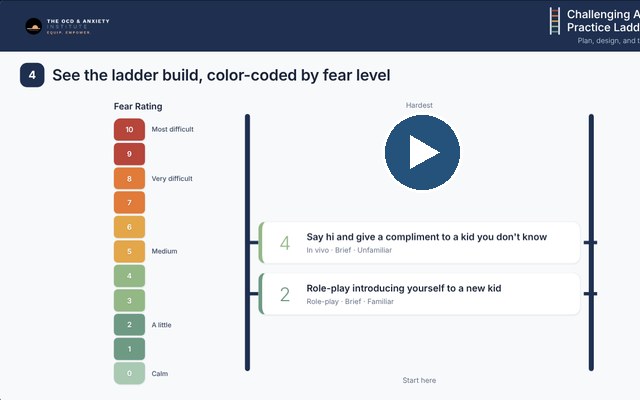
The first choice of treatment for OCD in kids is cognitive behavioral therapy with exposure and response prevention. With a therapist's help, the child builds a practice ladder of OCD triggers, from easiest to hardest. Step by step, they face each trigger and practice not doing the compulsion. Over time they learn that the anxiety fades on its own, that they can handle it, and that the feared outcome doesn't happen.
Treatment is usually weekly for about 12 to 20 sessions, with practice at home between sessions. Parents learn to coach practice and cut back accommodation. Sessions by video can work well, because kids can practice right where OCD shows up.
Medication
SSRI medications can also help, especially when OCD is moderate to severe. A child psychiatrist or pediatrician prescribes and monitors them. In the NIH-funded Pediatric OCD Treatment Study (POTS), published in JAMA in 2004, CBT, sertraline, and the two combined all helped, and the combination helped most. A follow-up study, published in JAMA in 2011, found that kids already taking medication improved more when they added full CBT with exposure. Dr. Khanna was a co-investigator on these trials.
Ask any therapist: "Do you use exposure and response prevention for OCD?" The answer should be yes. Talk therapy that only discusses feelings, without exposure, is not the recommended treatment for OCD.
What you can do today

- Name OCD as something separate. "That sounds like OCD talking" helps your child see OCD as a bully they can stand up to, not as who they are.
- Show you understand, and that you believe in them. "I know this feels really scary. I also know you can handle it."
- Don't argue with the thought. Logic rarely works, because OCD always has another "what if."
- Go easy on reassurance. Answer once, then gently point it out: "I think OCD is asking that question. What could you tell it?"
- Praise practice, not perfection. Notice every time your child faces a trigger or delays a ritual, even a little.
- Keep up fun and routines, and take care of yourself too. Supporting a child with OCD is hard work.
Free tools


Finding help
Get treatment with our team
The OCD & Anxiety Institute, founded by Dr. Muniya Khanna, offers evaluation and CBT with exposure for kids, teens, and young adults with anxiety and OCD, in person in Berwyn, PA and by video across Pennsylvania.
Find a provider
Looking for care in person or outside of Pennsylvania? Start with a directory below.
 Referral NetworkCoping Cat trained clinicians worldwideSearch by location or specialtyFind a clinician →
If you are unable to find a treatment provider through these or other websites, you can:
- Contact the psychiatry department at a local medical school or a university psychology department.
- Contact your county mental health department, a local hospital, or a community mental health center and ask about mental health clinics or staff psychiatrists.
- Search through your insurance company for local behavioral health or psychiatry providers.
- Search the American Psychological Association provider database.
Disclaimer: We do not endorse the references or providers listed. We list available resources as a service.
Books
Books for kids
A reading list for children and teens, organized by age.
Reading level 4 to 8 10 books
- First Day Jittersby Julie Danneberg. Whispering Coyote Press, 2000.
- Wemberly Worriedby Kevin Henkes. Greenwillow Books, 2010.
- Scary Night Visitors: A Story for Children with Bedtime Fearsby Irene Wineman Marcus, Paul Marcus, & Susan Jesche. Magination Press, 1990.
- I Don’t Know Why…I Guess I’m Shy: A Story About Taming Imaginary Fearsby Barbara Cain & J. J. Smith-Moore. Magination Press, 2000.
- Into the Great Forest: A Story for Children Away from Parents for the First Timeby Irene Wineman Marcus. Magination Press, 1992.
- Night Light: A Story for Children Afraid of the Darkby Jack Dutro & Kenneth Boyle. Magination Press, 1991.
- Cat’s Got Your Tongue? A Story for Children Afraid to Speakby Charles E. Schaefer & Judith Friedman. Magination Press, 1992.
- Outsmart Your Worry Tool Kit for Kids, Ages 5-11by Tool Kits for Kids, LLC, 2008.
- Lions Aren’t Scared of Shots: A Story for Children About Visiting the Doctorby Howard J. Bennett. Magination Press, 2007.
- Sometimes I’m Scaredby Jane Annunziata & Marc Nemiroff. Magination Press, 2009.
Reading level 9 to 12 8 books
- Nobody’s Perfect: A Story for Children about Perfectionismby Ellen Flanagan Burns. Magination Press, 2009.
- What to Do When You Worry Too Much: A Kid’s Guide to Overcoming Anxietyby Dawn Huebner. Magination Press, 2006.
- What to Do When Your Brain Gets Stuck: A Kid’s Guide to Overcoming OCDby Dawn Huebner. Magination Press, 2007.
- Up and Down the Worry Hill: A Children’s Book about Obsessive-Compulsive Disorder and its Treatmentby Aureen Pinto Wagner & Paul A. Jutton. Lighthouse Press, Inc., 2004.
- I Bet I Won’t Fret: A Workbook to Help Children With Generalized Anxiety Disorderby T.A. Sisemore. New Harbinger, 2008.
- Outsmart Your Worry Tool Kit for Kids, Ages 11-18by Tool Kits for Kids, LLC, 2009.
- Kissing Doorknobsby Terry Spencer Hesser. Laurel Leaf, 1999.
- Blink, Blink, Clop, Clop: Why We Do Things We Can’t Stopby E. Katia Moritz. Weston Press, 2011.
For teens 5 books
- My Anxious Mind: A Teen’s Guide to Managing Anxiety and Panicby Michael A. Tompkins, Katherine A. Martinez, & Michael Sloan. Magination Press, 2009.
- Outsmart Your Worry Tool Kit for Kids, Ages 11-18by Tool Kits for Kids, LLC, 2009.
- Free From OCD: A Workbook for Teens With Obsessive Compulsive Disorderby T.A. Sisemore, 2010.
- Perfectionism: What’s Bad About Being Too Goodby Miram Adderholdt & Jan Goldberg. Free Spirit Publishing, 1999.
- Talking Back to OCD: The Program That Helps Kids and Teens Say "No Way", and Parents Say "Way to Go"by John March, 2006.
Books for parents & caregivers
Books to empower those who support children and teens.
Anxiety 11 books
- The Resilience Recipeby Muniya Khanna & Philip Kendall (2021). New Harbinger Press.
- You and Your Anxious Child: Free Your Child from Fears and Worries and Create a Joyful Family Lifeby Anne Marie Albano, with Leslie Pepper. A Lynn Sonberg Book with Avery/Penguin Press, 2013.
- The Coping Cat: Parent Companionby Philip C. Kendall, Jennifer Podell, & Erika Gosch. Workbook Publishing, 2010.
- The Highly Sensitive Child: Helping Our Children Thrive When the World Overwhelms Themby Elaine Aron. Three Rivers Press, 2002.
- Freeing Your Child from Anxiety: Powerful, Practical Solutions to Overcome Your Child’s Fears, Worries and Phobiaby Tamar Chansky. Broadway Books, 2004.
- Freeing Your Child from Negative Thinking: Powerful, Practical Strategies to Build a Lifetime of Resilience, Flexibility and Happinessby Tamar Chansky. Da Capo Lifelong Books, 2008.
- Your Anxious Child: How Parents and Teachers Can Relieve Anxiety in Childrenby John Dacey & Lisa Fiore. Jossey-Bass, 2001.
- Helping Your Child Overcome Separation Anxiety or School Refusal: A Step-by-Step Guide for Parentsby Andrew R. Eisen, Linda B. Engler, & Joan Sparrow. New Harbinger Publications, 2006.
- The Worried Child: Recognizing Anxiety in Children and Helping Them Healby Paul Foxman. Hunter House, 2004.
- Help for Worried Kids: How Your Child Can Conquer Anxiety & Fearby Cynthia Last. Guilford Press, 2006.
- Helping Your Anxious Child: A Step-by-Step Guide for Parentsby Ronald Rapee, Susan Spence, Vanessa Cobham, & Ann Wignall. New Harbinger Publications, 2008.
OCD 3 books
- Freeing Your Child from Obsessive Compulsive Disorder: A Powerful, Practical Program for Parents of Children and Adolescentsby Tamar Chansky. Three Rivers Press, 2001.
- OCD in Children and Adolescents: A Cognitive-Behavioral Treatment Manualby John S. March & Karen Mulle. Guilford Press, 1998.
- What to Do When Your Child Has Obsessive-Compulsive Disorder: Strategies and Solutionsby Aureen Pinto Wagner. Lighthouse Press, 2002.